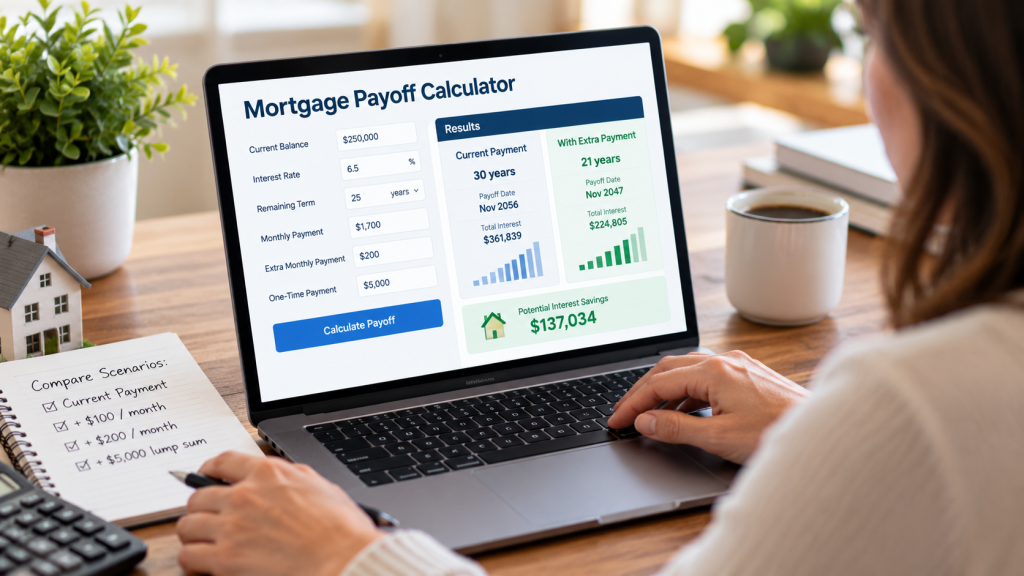
Making extra payments toward a mortgage is a familiar way to reduce an outstanding balance sooner. However, homeowners researching early payoff strategies may also encounter programs or planning methods described as mortgage acceleration.
The two approaches are closely related, but they are not always identical.
The main difference between mortgage acceleration and extra payments is that extra principal payments describe a specific repayment action, while mortgage acceleration is a broader approach to shortening the loan term.
A structured mortgage acceleration strategy may include additional payments alongside cash-flow analysis, repayment projections, or other financial arrangements.
Neither approach automatically guarantees a particular payoff date or amount of interest savings.
The important question is not which method has the more appealing name. It is what actually changes in the mortgage repayment schedule, how much money is required, and whether the approach fits the homeowner’s financial situation.
Understanding these distinctions can help homeowners compare their options without relying on generalized promises.
Mortgage Acceleration vs. Extra Payments: What’s the Difference?
Simply making extra mortgage payments generally involves contributing more than the required amount and directing the additional funds toward principal.
For example, a homeowner might pay an additional $100 every month or make a larger principal payment when sufficient money becomes available.
When the mortgage servicer applies those funds correctly, the outstanding balance decreases.
Mortgage acceleration is a broader term describing strategies intended to shorten the repayment period.
Some acceleration approaches rely entirely on extra principal payments. Others involve more detailed financial planning or different repayment arrangements.
Extra Payments Focus on Principal Reduction
Extra principal payments are relatively straightforward.
The homeowner determines an additional amount they can afford and arranges for it to be credited toward the outstanding balance.
This approach may not require specialized software, a separate program, or changes to the existing mortgage agreement.
Its effectiveness depends on the amount contributed, payment timing, and loan terms.
For many homeowners, the simplicity of this method is an important consideration.
Mortgage Acceleration May Involve More Planning
A structured mortgage acceleration strategy may examine repayment decisions alongside household income, expenses, financial reserves, and payment timing.
Some programs use software to compare projected payoff scenarios or organize financial information.
Other arrangements may involve additional accounts or financial products.
These differences matter because the cost, complexity, and financial commitments can vary.
A structured approach is not automatically more effective than making extra payments directly.
The actual outcome depends on what the strategy changes and whether any additional costs are justified.
Homeowners can explore the broader concept through mortgage acceleration strategies and their role in repayment planning.
How Each Approach Uses Household Cash Flow
One practical difference between simply making extra payments and using a structured acceleration approach is how available money is evaluated.
Making Extra Payments From Available Income
A homeowner making additional principal payments might begin with a monthly household budget.
After accounting for mortgage payments, utilities, groceries, insurance, savings, and other obligations, the homeowner identifies money that may be available for additional repayment.
Suppose a household determines that an additional $150 per month could be directed toward principal.
The homeowner may choose to make that additional payment consistently, provided doing so remains financially practical.
The process does not necessarily require a comprehensive repayment system.
However, it still requires judgment about what the household can afford.
Using Cash-Flow Planning
A more structured mortgage acceleration approach may examine the timing of household income and expenses.
For example, a homeowner might receive income twice a month while paying bills on several different dates.
An account balance immediately after payday may appear substantial, but some of those funds could already be needed for upcoming obligations.
Cash-flow planning helps distinguish money temporarily available in an account from funds that can realistically be committed to mortgage repayment.
This distinction matters when evaluating a strategy that relies on payment timing or account balances.
Financial Flexibility Matters in Both Approaches
Money applied toward mortgage principal generally increases home equity, but it does not remain readily available for ordinary household expenses.
Accessing that equity later may require selling the property or qualifying for another financial arrangement.
Homeowners should therefore consider emergency reserves, property maintenance, medical expenses, retirement contributions, and other priorities.
A repayment strategy that produces an attractive projected payoff date may be unsuitable if it leaves the household without sufficient cash reserves.
The amount available for repayment should reflect actual financial circumstances rather than an aggressive target.
How Mortgage Acceleration and Extra Payments Affect Interest
Both approaches may reduce future interest when they successfully lower the outstanding principal earlier than the original repayment schedule.
The mortgage does not calculate interest differently simply because a repayment method is called an acceleration strategy.
The Same Principal Reduction Can Produce the Same Result
Consider two homeowners with identical fixed-rate mortgages.
Both have the same outstanding balance, interest rate, remaining term, and required payment.
Suppose both make an additional $200 principal payment on the same date, and their mortgage servicers apply the funds identically.
All else being equal, the additional principal reduction would generally have the same effect on their respective loan balances and subsequent interest calculations.
Calling one method mortgage acceleration would not create a separate financial advantage.
This is an important distinction when comparing repayment strategies.
The benefit comes from the actual change in the loan balance and payment schedule, not from the terminology used to describe it.
When Results May Differ
Results can differ when homeowners make additional payments of different amounts or at different times.
For example, one approach may result in regular monthly principal reductions.
Another may involve less frequent payments or a schedule influenced by available household cash flow.
Different payment amounts and dates can lead to different projected payoff schedules.
A complete comparison should use accurate loan information and account for how each payment is applied.
Consider Costs Beyond Mortgage Interest
Some mortgage acceleration programs may involve fees, additional borrowing arrangements, or other financial expenses.
These costs should be considered alongside any projected reduction in mortgage interest.
A strategy that appears favorable when examining mortgage interest alone may be less attractive when additional expenses are included.
Homeowners should compare the overall financial implications, not simply the projected number of months removed from the repayment schedule.
An earlier payoff is meaningful only when evaluated alongside the resources required to achieve it.
Comparing Flexibility, Complexity, and Financial Commitments
The distinction between extra principal payments and structured mortgage acceleration becomes clearer when the approaches are compared across practical considerations.
| Consideration | Extra Principal Payments | Structured Mortgage Acceleration |
| Primary focus | Direct principal reduction | Broader repayment planning |
| Financial review | May use a basic household budget | May include detailed cash-flow analysis |
| Payment schedule | Chosen within mortgage requirements | Depends on the selected approach |
| Software | Not inherently required | May involve planning software |
| Additional costs | Depend on mortgage terms and arrangements | May include program or account expenses |
| Flexibility | Depends on voluntary payment choices | Depends on program terms and obligations |
Simplicity Versus Structure
Some homeowners prefer a straightforward repayment method.
They may already understand their financial situation and know how much additional principal they can contribute.
For these homeowners, a simple additional-payment approach may be easier to manage.
Others may want a structured process that compares several repayment scenarios or examines how household cash flow changes over time.
The added structure may help organize financial information, but it should provide a clear practical benefit.
What to Review Before Using a Program
Before considering a mortgage acceleration program, homeowners should understand the arrangement.
Important questions include:
- What does the program do beyond ordinary extra principal payments?
- Does it require a separate account or borrowing arrangement?
- Are setup fees or ongoing expenses involved?
- How are projected payoff dates calculated?
- What happens if income or expenses change?
- Can the homeowner modify or discontinue the arrangement?
- Are there contractual obligations beyond the existing mortgage?
Answers to these questions help establish what the program provides and whether its requirements fit the homeowner’s circumstances.
Evaluating the Tradeoffs
A repayment method should be assessed using more than one measurement.
A shorter projected loan term may be appealing, but additional payments also reduce the money available for other purposes.
Homeowners should consider the amount committed, expected interest effects, fees, flexibility, and impact on household reserves.
For a broader understanding of repayment options, the mortgage payoff strategy guide provides additional educational context.
Which Approach Should Homeowners Consider?
There is no universal answer to whether mortgage acceleration or straightforward extra principal payments are preferable.
The decision depends on the homeowner’s loan information, financial resources, and priorities.
Someone with predictable income and an established budget may prefer making voluntary additional principal payments.
Another homeowner may want to compare several repayment scenarios before deciding how to allocate available funds.
Both situations involve legitimate planning considerations.
Start With Accurate Mortgage Information
Before evaluating either approach, homeowners should review:
- Outstanding mortgage principal
- Interest rate
- Remaining repayment term
- Required principal-and-interest payment
- Rules for additional principal payments
- Applicable prepayment penalties or restrictions
This information establishes the current repayment position.
It also helps prevent comparisons based on inaccurate assumptions.
Compare Realistic Repayment Scenarios
A useful evaluation compares the existing payment schedule with one or more alternatives.
Each scenario should account for the amount of additional money required, when it would be applied, and the resulting estimated payoff timeline.
If a structured program is involved, applicable fees and other financial obligations should also be included.
Projected results should be treated as estimates rather than guaranteed outcomes.
Choose a Sustainable Financial Commitment
A repayment approach should fit within the household’s broader financial plan.
It should not require neglecting emergency savings, essential expenses, or other important obligations.
Homeowners may also need to adjust their approach when circumstances change.
The best comparison is therefore not necessarily the one with the earliest projected payoff date.
It is the one that provides a realistic understanding of the repayment choices and their financial consequences.
United Financial Freedom provides educational information about mortgage payoff planning and the considerations involved in evaluating earlier repayment.
Interested in Exploring Your Mortgage Payoff Options?
Understanding the differences between extra principal payments and structured mortgage acceleration can help you decide which repayment questions deserve closer examination.
Review the factors involved in evaluating an earlier payoff, including payment timing, household cash flow, and mortgage terms.
Explore Mortgage Acceleration Options
FREQUENTLY ASKED QUESTIONS
Is mortgage acceleration better than making extra payments?
Not necessarily. Extra principal payments are one method of accelerating mortgage repayment. A structured strategy may include additional planning or financial arrangements, but its value depends on the actual repayment effect, associated costs, and homeowner circumstances.
Can I make extra principal payments without joining a program?
Many homeowners can make additional principal payments without enrolling in a separate program, subject to their mortgage terms. It is important to confirm how the loan servicer applies additional funds and whether any restrictions apply.
Will mortgage acceleration always save more interest than extra payments?
No. If two approaches reduce the same mortgage principal by the same amounts on the same dates, their direct effect on mortgage interest will generally be the same, assuming identical loan terms and payment processing.
Are mortgage acceleration programs always expensive?
Costs vary by program and arrangement. Some approaches may involve fees, software expenses, or additional financial products. Homeowners should review all applicable costs before comparing a program with making extra principal payments directly.
Can I stop making extra mortgage payments if my finances change?
Voluntary extra principal payments can often be reduced or discontinued while required mortgage payments continue. However, flexibility depends on the mortgage terms and any separate agreements. Homeowners should review their obligations before making changes.