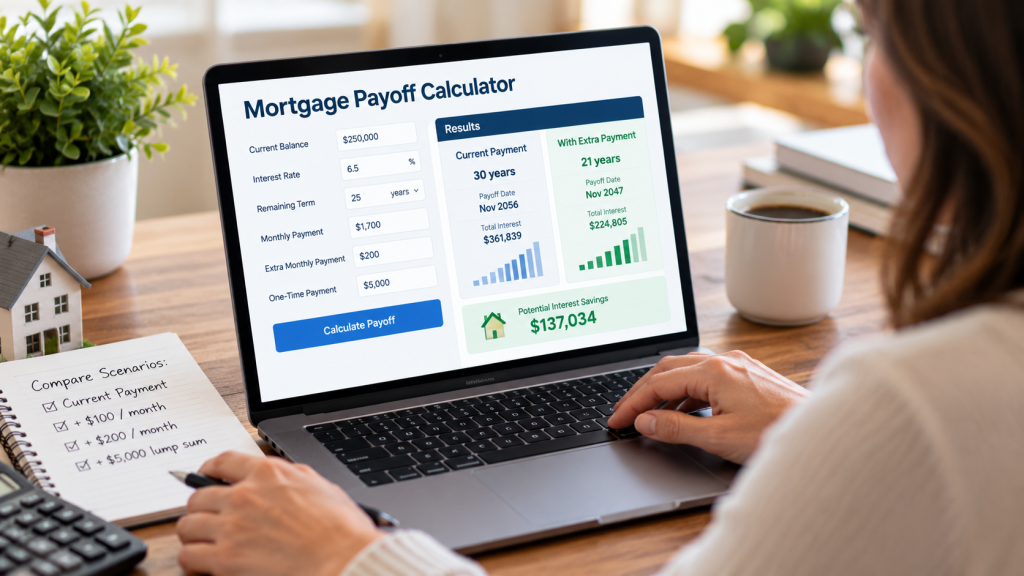
A 30-year mortgage establishes a repayment schedule, but it does not necessarily represent the earliest date a homeowner could pay off the loan. Changes to how principal is repaid may shorten that timeline without requiring a replacement mortgage.
Mortgage acceleration is an approach intended to reduce the outstanding mortgage balance faster than the original repayment schedule requires. It may involve making additional principal payments, changing payment arrangements, or using a structured cash-flow plan.
Understanding how mortgage acceleration works begins with knowing how principal, interest, and payment timing interact.
An additional payment can affect the loan differently depending on how the mortgage servicer processes it. Payment frequency, the remaining loan term, and household financial priorities also matter.
For homeowners considering an earlier payoff, understanding these mechanics provides a foundation for evaluating repayment options without relying on guaranteed savings or unrealistic timelines.
What Does Mortgage Acceleration Mean?
Mortgage acceleration describes the process of reducing a mortgage balance ahead of its original repayment schedule.
Most traditional fixed-rate mortgages use amortization, meaning the loan is repaid through scheduled payments over a specified term, often 15 or 30 years.
For a standard 30-year mortgage, the repayment calculation generally assumes 360 monthly principal-and-interest payments.
If payments follow the original schedule, the loan balance gradually declines until it reaches zero at the end of the term.
Mortgage acceleration changes that pattern by reducing principal sooner.
For example, a homeowner may make a regular additional principal payment beyond the required monthly amount. Another homeowner may apply occasional extra funds toward the outstanding balance.
Both approaches can affect the remaining repayment schedule, although their financial requirements and outcomes differ.
Does Mortgage Acceleration Change the Interest Rate?
A common misunderstanding is that paying off a mortgage faster requires obtaining a lower interest rate.
That is not necessarily the case.
Homeowners may retain their existing mortgage while changing how quickly principal is repaid.
For a fixed-rate loan, the contractual interest rate generally remains unchanged when additional principal payments are made.
The potential effect comes from reducing the outstanding balance used to calculate future interest.
This is why mortgage acceleration and refinancing are different concepts.
For homeowners considering broader approaches to early repayment, understanding the available mortgage payoff strategies can provide additional context.
Mortgage Acceleration Is Not One Specific Product
The term may describe several repayment approaches.
Some involve straightforward additional payments. Others focus on payment schedules, cash-flow analysis, or structured financial planning.
A mortgage acceleration program may also incorporate software or other financial arrangements.
The important distinction is that acceleration describes the intended earlier repayment outcome, while the individual method explains how that outcome is pursued.
How Principal and Interest Affect Mortgage Repayment
A typical mortgage payment includes principal and interest.
Principal is the outstanding amount borrowed. Interest is the borrowing cost calculated under the mortgage agreement.
For a standard fixed-rate, fully amortizing mortgage, the scheduled principal-and-interest payment generally remains consistent while the proportions allocated to each component change.
Early in repayment, a larger portion often goes toward interest because the outstanding balance is relatively high.
As principal decreases, less interest generally accrues between scheduled payments, allowing more of the regular payment to reduce the balance.
What Happens When Principal Is Reduced Early?
Consider a homeowner with an outstanding mortgage balance of $250,000.
Suppose the homeowner makes an additional $1,000 payment applied entirely toward principal.
Ignoring other transactions occurring at the same time, the balance declines to $249,000.
This does not mean the homeowner has immediately saved $1,000 in interest.
Instead, the reduced balance changes the amount on which subsequent interest may be calculated.
With many amortizing mortgages, earlier principal reduction can lower future interest compared with following the original repayment schedule.
The difference depends on the loan’s rate, remaining term, payment timing, and specific terms.
A Simple Mortgage Interest Example
Assume a hypothetical mortgage balance of $250,000 with a fixed annual interest rate of 6%.
Using a simplified monthly-interest calculation:
- Annual interest rate: 6%
- Illustrative monthly interest rate: 0.5%
- Monthly interest on $250,000: $1,250
If the starting balance were instead $249,000, the illustrative interest amount would be $1,245.
That represents a difference of $5 for that example month.
This calculation demonstrates the effect of a smaller balance. It does not represent guaranteed savings or an actual lender’s complete amortization calculation.
Interest-accrual conventions and mortgage terms may change the actual figures.
Over many payment periods, the relationship between scheduled payments and outstanding principal determines how the mortgage balance changes.
How Do Accelerated Mortgage Payments Work?
An accelerated repayment approach generally involves reducing principal beyond what the original schedule requires.
The existing contractual payment normally remains due unless the lender formally changes the agreement.
Additional principal payments do not ordinarily eliminate the obligation to make future scheduled payments.
Making Additional Monthly Principal Payments
One approach involves contributing a consistent amount beyond the required payment.
For example, a homeowner with a $1,500 required principal-and-interest payment might choose to add $100 specifically toward principal.
The regular payment satisfies the scheduled obligation, while the additional amount further reduces the balance when properly credited.
Continuing this approach may cause the balance to decline faster than originally projected.
However, the effect depends on the total amount contributed, when payments are processed, and the remaining loan terms.
Making Occasional Additional Payments
Some homeowners prefer occasional principal payments rather than committing to a fixed additional amount every month.
These payments may come from funds available after essential expenses, savings, and other obligations have been addressed.
An additional payment does not need to occur every month to affect the balance.
However, homeowners should avoid committing money needed for emergency savings or anticipated household expenses.
The important consideration is whether the funds are genuinely available for repayment.
Understanding Payment Frequency
Some repayment arrangements involve payments more frequently than once per month.
For example, making half of a monthly payment every two weeks produces 26 half-payments annually, equivalent to 13 full monthly payments.
This differs from dividing 12 monthly payments into smaller installments without increasing the annual amount paid.
However, the outcome depends on how the mortgage servicer accepts and applies payments.
Some servicers hold partial payments until enough funds are received for a complete monthly installment.
Before changing payment frequency, homeowners should confirm payment-processing rules, fees, and any applicable restrictions.
Why Does Payment Timing Matter?
Mortgage acceleration is affected not only by how much principal is paid but also by when the payment is applied.
A reduction made earlier in the repayment schedule may influence interest calculations over more remaining payment periods.
A similar reduction made near the end of the mortgage has fewer remaining periods in which to affect interest.
That difference helps explain why two homeowners making identical additional payments may not experience identical results.
Contractual Term Versus Projected Payoff Date
The contractual mortgage term is the repayment period established in the loan agreement.
The projected payoff date is the date the balance is expected to reach zero under a specific set of payment assumptions.
A homeowner may retain a 30-year mortgage while calculating an earlier payoff date based on additional principal payments.
The contractual term does not necessarily change simply because the projected payoff date changes.
Why Projections Can Change
An accelerated payoff estimate relies on assumptions about future payments and financial circumstances.
Those assumptions may change because of:
- Changes in income
- Unexpected household expenses
- Adjustments to additional payment amounts
- Changes in payment timing
- Loan provisions or payment-processing requirements
A homeowner who temporarily stops making additional payments may experience a different payoff timeline from the original projection.
This is why estimated payoff dates should be treated as planning scenarios rather than guaranteed outcomes.
Homeowners interested in the broader decisions behind an earlier payoff can also review how to pay off a mortgage faster.
How Cash Flow Connects to Mortgage Acceleration
Some mortgage acceleration approaches examine the relationship between household income, expenses, and repayment timing.
Cash flow describes the money entering and leaving a household during a particular period.
Income may arrive weekly, twice monthly, or at irregular intervals, while expenses occur according to different schedules.
Understanding these patterns can help homeowners determine when funds are available and what obligations must be covered.
Available Cash Is Not Always Financial Surplus
A household may have money remaining after paying regular monthly bills.
However, that balance may still be needed for irregular expenses, property maintenance, insurance adjustments, or emergency reserves.
A temporary account balance should not automatically be treated as money available for additional mortgage payments.
Responsible cash-flow planning considers upcoming obligations as well as current expenses.
How Mortgage Payoff Software Fits In
Some homeowners use calculators or mortgage payoff software when evaluating repayment alternatives.
Depending on the particular tool, it may model balances, payment amounts, and estimated payoff dates.
The usefulness of these projections depends on the calculations and information entered.
Software does not eliminate the financial tradeoffs associated with directing additional money toward mortgage principal.
Homeowners should understand what a particular tool measures, what assumptions it uses, and whether additional financial arrangements are involved.
The broader mortgage acceleration strategy provides further context for evaluating repayment approaches and their potential role in homeowner financial planning.
Understanding Your Next Step
Learning how mortgage acceleration works is different from deciding whether a particular strategy fits your financial circumstances.
Before adjusting mortgage payments, review the outstanding balance, interest rate, remaining term, household cash flow, and applicable loan provisions.
Confirm how the mortgage servicer applies additional funds and whether any payment restrictions or fees apply.
Also consider the effect of committing money toward principal.
Home equity is not the same as immediately available cash. Once funds are applied to principal, accessing that equity may require selling the property or obtaining another financial product, potentially involving costs and risks.
A responsible decision should account for household reserves, competing financial priorities, and the flexibility needed for unexpected expenses.
Understanding these factors can help homeowners compare repayment choices more carefully.
Ready to Explore Your Mortgage Acceleration Options?
United Financial Freedom provides educational information about mortgage payoff planning and the financial considerations involved in evaluating earlier repayment.
Learn more about the factors that influence mortgage payoff timelines and what to review before selecting an approach.
Explore Mortgage Acceleration Options
FREQUENTLY ASKED QUESTIONS
What makes a mortgage payment accelerated?
A mortgage payment contributes to acceleration when it reduces principal faster than the original repayment schedule requires. This may occur through additional principal payments or another repayment arrangement that produces earlier principal reduction.
Do extra mortgage payments automatically shorten the loan?
Not always. The outcome depends on how the mortgage servicer applies the payment, the loan terms, and whether the additional funds reduce principal. Homeowners should confirm payment instructions and review their updated balance.
Does changing mortgage payment frequency reduce interest?
Changing payment frequency may affect the repayment schedule, but it does not automatically reduce interest. The result depends on the total amount paid, payment timing, how funds are credited, and the mortgage’s interest-calculation rules.
Why do mortgage acceleration estimates change?
Estimates depend on assumptions about the outstanding balance, interest rate, additional payments, and payment timing. Changes to those assumptions can produce a different projected payoff date.
Can mortgage acceleration work without specialized software?
Yes. Additional principal payments can change the payoff timeline without specialized software. Software may help homeowners compare scenarios, but the underlying repayment effect depends on principal reduction and the mortgage’s terms.