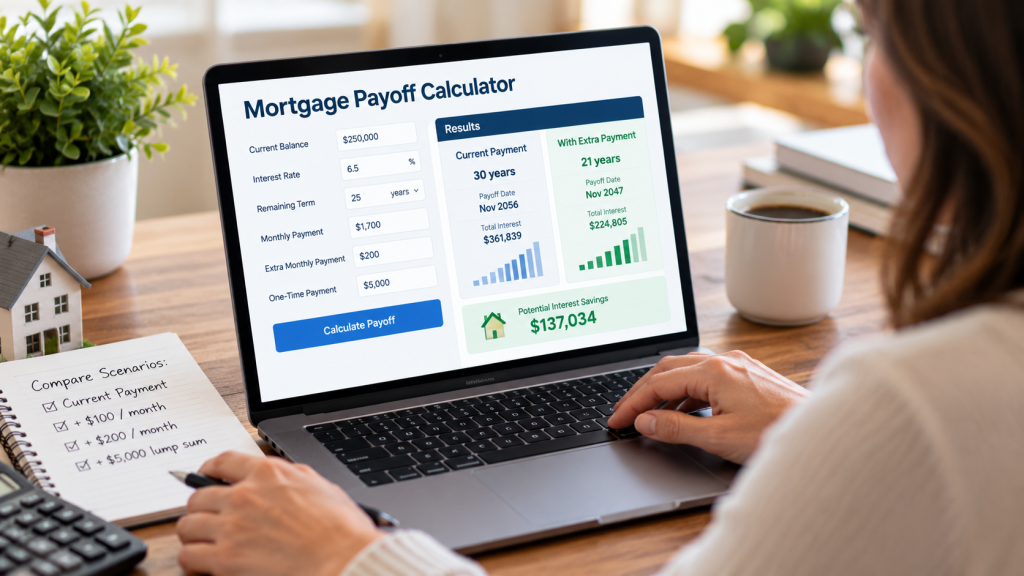
A 30-year mortgage provides a predictable repayment schedule, but homeowners are not necessarily required to use all 30 years to repay the loan. Depending on the mortgage agreement, additional principal payments may allow the outstanding balance to reach zero sooner.
That raises a practical question: Can you shorten a 30-year mortgage without refinancing?
Yes. Many homeowners can shorten a 30-year mortgage without refinancing by making additional principal payments while keeping their existing loan. The results depend on the balance, interest rate, remaining term, payment timing, and how additional funds are processed.
Refinancing replaces an existing mortgage with another loan. Paying ahead on the current mortgage can change the projected payoff date without replacing the original agreement.
For financially stable homeowners, particularly those who purchased within the past few years, understanding this distinction can make early repayment planning more practical.
The important consideration is not simply how quickly the loan could disappear. It is whether the repayment adjustments are affordable, sustainable, and appropriate for the household’s broader financial priorities.
Can a 30-Year Mortgage Really Be Paid Off Early?
A traditional 30-year fixed-rate mortgage is generally calculated to repay the original principal through 360 scheduled monthly principal-and-interest payments.
Each installment reduces part of the outstanding balance while covering interest calculated under the loan agreement.
If all payments follow the original schedule and the loan terms remain unchanged, repayment generally continues until the contractual maturity date.
However, additional principal payments can change that schedule.
When funds are correctly credited toward principal, the outstanding amount decreases faster than originally projected. On many fully amortizing mortgages, this can reduce subsequent interest charges and shorten the remaining repayment period.
Your Original Term Does Not Have to Be Your Payoff Date
The contractual mortgage term and projected payoff date describe different things.
The contractual term is the repayment period established in the mortgage agreement.
The projected payoff date is when the remaining balance is expected to reach zero under a particular payment schedule.
A homeowner could retain a 30-year mortgage while calculating an earlier payoff date based on additional principal payments.
The original agreement does not necessarily change simply because the homeowner expects to complete repayment sooner.
Keeping Your Existing Interest Rate
Homeowners sometimes assume that shortening a mortgage requires changing its interest rate.
For a fixed-rate loan, making additional principal payments generally leaves the contractual interest rate unchanged.
The potential benefit comes from reducing the principal on which future interest is calculated.
That distinction is important when considering an accelerated mortgage payoff.
Homeowners can learn more about this broader concept through mortgage acceleration strategies.
What Can You Change Without Refinancing?
Keeping an existing mortgage does not mean every part of the repayment process must remain unchanged.
Depending on the loan agreement, homeowners may be able to increase principal payments, make occasional additional payments, or change how they schedule repayment.
The required monthly principal-and-interest payment usually remains the same unless the lender formally changes the agreement.
Increase Monthly Principal Payments
One straightforward option is to pay more than the required monthly amount.
Suppose a homeowner’s scheduled principal-and-interest payment is $1,500.
If the household can comfortably afford another $100, that amount may be directed toward principal.
When properly credited, the additional funds lower the outstanding balance beyond the reduction already included in the scheduled payment.
Continuing this practice can change the estimated payoff date.
However, the homeowner must still make required payments, and the additional amount should be evaluated against other financial obligations.
Make Occasional Larger Payments
Not every household has the same amount of money available each month.
Some homeowners may prefer occasional principal reductions when additional funds become available.
For example, money remaining after necessary expenses and savings contributions could potentially be used toward a larger principal payment.
The payment may reduce the balance even if it is not repeated regularly.
However, homeowners should consider upcoming maintenance, taxes, insurance, and other obligations before committing those funds.
Review Payment Frequency
Some borrowers consider biweekly repayment arrangements.
Making half of a monthly payment every two weeks results in 26 half-payments annually, equivalent to 13 full monthly payments.
That can increase the annual amount paid compared with making 12 regular monthly payments.
However, the result depends on how the mortgage servicer processes partial payments, whether fees apply, and when money is credited.
A payment-frequency change does not automatically produce savings merely because transactions occur more often.
The homeowner should confirm the arrangement before enrolling or changing payment instructions.
How Much Earlier Could a 30-Year Mortgage Be Paid Off?
A mortgage payoff calculation can help homeowners compare the original repayment schedule with an alternative involving additional principal.
The results depend on the specific mortgage and the assumptions used.
A Hypothetical Mortgage Example
Consider the following newly originated fixed-rate mortgage:
| Mortgage detail | Hypothetical amount |
| Original principal | $240,000 |
| Annual interest rate | 6% |
| Original term | 30 years |
| Scheduled principal-and-interest payment | Approximately $1,439 |
| Additional principal payment | $100 monthly |
With the scheduled payment alone, the mortgage is designed for repayment over 360 months.
Now assume the homeowner makes an additional $100 toward principal every month, beginning with the first payment.
Using standard monthly amortization assumptions, the estimated payoff occurs during month 304 rather than month 360.
That represents approximately 56 months, or four years and eight months, earlier than the original schedule.
The estimated reduction in lifetime mortgage interest is approximately $51,000.
These are rounded hypothetical calculations, not actual United Financial Freedom customer results. The example assumes consistent additional payments, a fixed interest rate, no prepayment penalty, and no change to the loan terms. It excludes taxes, insurance, and other costs.
Actual results may differ based on the mortgage agreement, interest-accrual conventions, and servicer practices.
What the Example Shows
The example demonstrates that additional principal payments can shorten a projected payoff timeline without refinancing.
It does not mean every homeowner will save the same amount or eliminate the same number of payments.
A homeowner who already has several years of repayment behind them will have a different starting balance and remaining term.
Likewise, a mortgage with a different rate or principal amount will produce different calculations.
The most useful comparison starts with the homeowner’s current loan information rather than a generic example.
Confirm How Extra Payments Are Applied
Before sending additional funds, homeowners should confirm how their mortgage servicer handles principal-only payments.
Extra funds intended to reduce principal should not be confused with payments credited toward future scheduled installments.
Reviewing updated mortgage statements can help verify that the balance changed as intended.
This matters because an early payoff projection assumes that additional funds actually reduce the outstanding principal.
What Remains the Same When You Avoid Refinancing?
Keeping the original mortgage preserves several contractual features that homeowners should understand.
For a typical fixed-rate mortgage, the interest rate remains unchanged, and the scheduled principal-and-interest payment usually stays the same.
Additional principal payments can affect the remaining balance without automatically changing the required monthly payment.
Your Required Payment Usually Does Not Decrease
A homeowner who makes a substantial principal payment may expect the next required monthly installment to become smaller.
That generally does not happen automatically.
Instead, the payment may reduce the amount of time needed to retire the loan if the normal required payments continue.
Some lenders offer mortgage recasting, which involves recalculating the required payment after an eligible principal reduction.
Recasting is different from refinancing and may involve separate eligibility requirements or fees.
Because a recast can lower the required payment, it does not necessarily shorten the repayment timeline if the homeowner makes only the newly calculated installments.
Existing Mortgage Conditions Still Matter
Keeping the current mortgage also means remaining subject to its provisions.
Before making additional payments, review:
- Prepayment restrictions or penalties, if applicable
- Payment processing requirements
- Rules for directing additional funds toward principal
- Any unusual interest or repayment provisions
Most ordinary discussions of accelerated payoff assume a conventional amortizing mortgage.
Interest-only loans, adjustable-rate arrangements, and other mortgage structures may require different calculations.
Homeowners should use the terms of their actual loan rather than assuming every mortgage behaves identically.
Avoiding a Replacement Loan Is Not the Same as Avoiding All Costs
Making additional principal payments typically does not involve the closing process associated with refinancing.
However, homeowners should not assume every repayment arrangement is free.
Optional payment services, special programs, or separate financial arrangements may involve costs.
Those expenses should be understood before choosing an approach.
When Is an Earlier Payoff Worth Considering?
A shorter mortgage payoff timeline may be attractive, especially for homeowners who want to reduce long-term borrowing costs.
However, an earlier payoff should be considered alongside other household priorities.
Money directed toward principal generally increases home equity but becomes less accessible for everyday expenses.
A homeowner may need sufficient reserves for repairs, insurance changes, medical expenses, or income interruptions.
Other financial obligations and long-term savings goals also deserve attention.
Before increasing payments, review the current mortgage balance, required installment, remaining term, available household cash flow, and accessible savings.
The additional amount should be realistic enough to maintain without compromising essential needs.
A useful repayment review should also account for changes in circumstances. A plan that works today may need adjustment after a major household expense or income change.
Homeowners who want a broader planning perspective can review how to pay off a mortgage faster.
Explore Your Mortgage Payoff Options
Shortening a 30-year mortgage without refinancing is possible for many homeowners, but the best approach depends on their existing loan and financial circumstances.
United Financial Freedom helps homeowners understand mortgage repayment strategies and the factors that can influence an earlier payoff.
Reviewing your current mortgage, available cash flow, and payment options can provide a clearer basis for evaluating your next steps.
Interested in Exploring an Earlier Mortgage Payoff?
Explore Mortgage Payoff Options With United Financial Freedom
FREQUENTLY ASKED QUESTIONS
Can I pay off a 30-year mortgage in 20 years without refinancing?
Potentially. Additional principal payments may shorten a 30-year mortgage to approximately 20 years, depending on the remaining balance, interest rate, payment amount, and timing. A loan-specific calculation is needed to determine what additional payments would be required.
Will paying extra principal automatically lower my monthly mortgage payment?
Usually not. On a typical fixed-rate mortgage, additional principal payments reduce the outstanding balance without automatically changing the required monthly principal-and-interest payment. The projected payoff date may change instead.
Do I need lender approval to make additional principal payments?
Many mortgages allow additional principal payments, but homeowners should review their loan terms and confirm the servicer’s procedures. Restrictions, penalties, or special payment requirements may apply to certain loans.
Is it possible to keep my current mortgage rate and pay off the loan early?
Yes. Homeowners with fixed-rate mortgages can often make additional principal payments while retaining their existing contractual interest rate. The earlier payoff results from reducing the balance faster, not from changing the rate.
Is shortening a mortgage term always the best financial decision?
Not necessarily. An earlier payoff should be considered alongside emergency savings, other financial obligations, retirement goals, and available cash flow. The appropriate approach depends on the homeowner’s broader financial circumstances.